
You type "sensory toys" and get: flashing Pop-Its, fidget balls in packs of ten, a wall full of Velcro. Everything promises development. And you stand there and wonder if your child really needs it – or if it's just more overstimulation in the end.
The short answer: Sensory toys can do a lot, but rarely what's written on the packaging. This guide clarifies what the term actually means, what is useful at what age, what to look out for when buying – and when less is actually more.
What are sensory toys?
Sensory toy is not a protected term and not a product category with fixed rules. It refers to toys that specifically appeal to one or more senses: touch, hearing, sight, smell, taste – as well as balance and body tension.
Behind it is the concept of sensory integration. The Society for Sensory Integration according to Jean Ayres describes it as "that neurological process in which sensory impressions from the environment and from the body are organized (processed) so that a person can use their body meaningfully within the environment". So it's not about providing as many stimuli as possible – but about a child learning to sort them.
In practical terms, this means: a bag of chestnuts is a sensory toy. A bowl of warm water, too. And the expensive tactile set from the online shop is not automatically better just because it says "sensory" on it.
The senses hardly anyone thinks about
Everyone knows the five classic senses. Two others are at least as important for development – and almost never appear in toy descriptions.
The Professional Association of Pediatricians and Adolescent Doctors (BVKJ) explicitly mentions two systems:
- The vestibular system – the sense of balance. Activities like "climbing, swinging and dancing" promote speech, sight, hearing, and motor development, according to the BVKJ.
- The proprioceptive system – the perception of one's own body in space. It is essential for the "correspondence between sight and body movement".
The association summarizes it as follows: "A child learns to coordinate the individual stimuli of the various sensory centers, to classify them correctly, and to react appropriately to them."
What this means for shopping is uncomfortable for the toy industry: a swing, a balance board, or a romp on the mattress cover two of the most important channels – and cost little to nothing.
At what age are sensory toys useful?
Strictly speaking, from day one, because children explore their environment through their senses from the beginning. Practically, however, what is suitable changes.
The following overview is a practical classification, not a developmental norm – children develop at different rates.
| Age | Focus | Typical materials |
|---|---|---|
| 0–1 year | Grabbing, feeling, mouth as a tool | Teething rings, touch-and-feel books, rattles, cloths |
| 1–3 years | Cause and effect, pouring, stacking | Water, sand, large building blocks, musical toys |
| 3–6 years | Creating, role-playing, perseverance | Playdough, clay, finger paints, natural materials |
| 6–9 years | Fine motor skills, rules, concentration | Tools, beads, experiments, tactile games with rules |
For the 3- to 6-year-old age group, the Federal Institute for Public Health (BIÖG) becomes specific, recommending, among other things, "plasticine, modeling clay, clay, sand", "finger paints", and natural materials such as "autumn leaves, chestnuts, pine cones, twigs, shells". Also, movement games like tightrope walking and "classic jumping and hopping games: hopscotch, skipping rope".
Remarkable about this list: not a single item is a purchased sensory product.
Sensory toys for babies
This is where the market is largest and the selection most confusing. Safety is paramount, as everything ends up in their mouths at this age – more on this below. Content-wise, a few different textures are completely sufficient. A baby doesn't need twelve tactile surfaces simultaneously.
From 1 year
Now begins the pouring, transferring, inserting. A bowl of water and two cups will occupy many children at this age longer than most purchased items. The setting is important: a towel underneath, clothes that can get wet, and time.
From 3 years
This is the point where sensory experiences transition into play – into stories, roles, and original ideas. Pure sensory materials lose their appeal if they don't tell a story. Playdough becomes cake, sand becomes a construction site. Anything that allows only a single use quickly becomes boring here.
From 6 years
For school children, interest shifts to fine motor skills, dexterity, and rules: tactile memory games, knotting, beading, small experiments. The need for retreat and sensory breaks also becomes clearer – after a school day, their energy is often depleted.
What makes a good sensory toy
The BIÖG, in its guide to appropriate toys, lists four criteria: Good toys are safe, sturdy and durable, versatile – they should be usable "in ever new ways and supplemented" – and age-appropriate.
Particularly relevant for the sensory category is the institute's warning against electronic toys: "If the toy dictates very specific ways of use or makes the child a passive observer (because it only needs to be switched on or wound up), children usually quickly lose interest."
This means that a good part of what is sold as sensory toys today fails the first test: what flashes, plays tunes, and reacts at the push of a button provides stimuli – but it doesn't demand anything.
| Open-ended sensory materials | Prescribed stimulus toys | |
|---|---|---|
| Example | Sand, playdough, water, chestnuts | Flashing tactile board, Pop-It with sound |
| Uses | many, invented by the child | one, predetermined by the product |
| Child's role | actively shaping | reacting (BIÖG: "passive observer") |
| Durability of interest | grows with the child | often short |
| Amount of stimuli | controllable | fixed |
| Cost | low to none | medium to high |
This does not mean that purchased sensory toys are inherently bad. A good balance board or a high-quality tactile memory game will last for years. The question is simply whether the product opens up possibilities for the child – or takes them away.
Making your own sensory toys: 8 ideas from around the house
Most sensory experiences are already lying around your home. All ideas are intended for children from about 3 years old and require supervision – for younger children, everything below about safety also applies.
- Mystery Box. A shoebox with a hole in the side. Put an object inside, the child feels it and guesses. Works from 3 years and becomes a guessing game with points from 6.
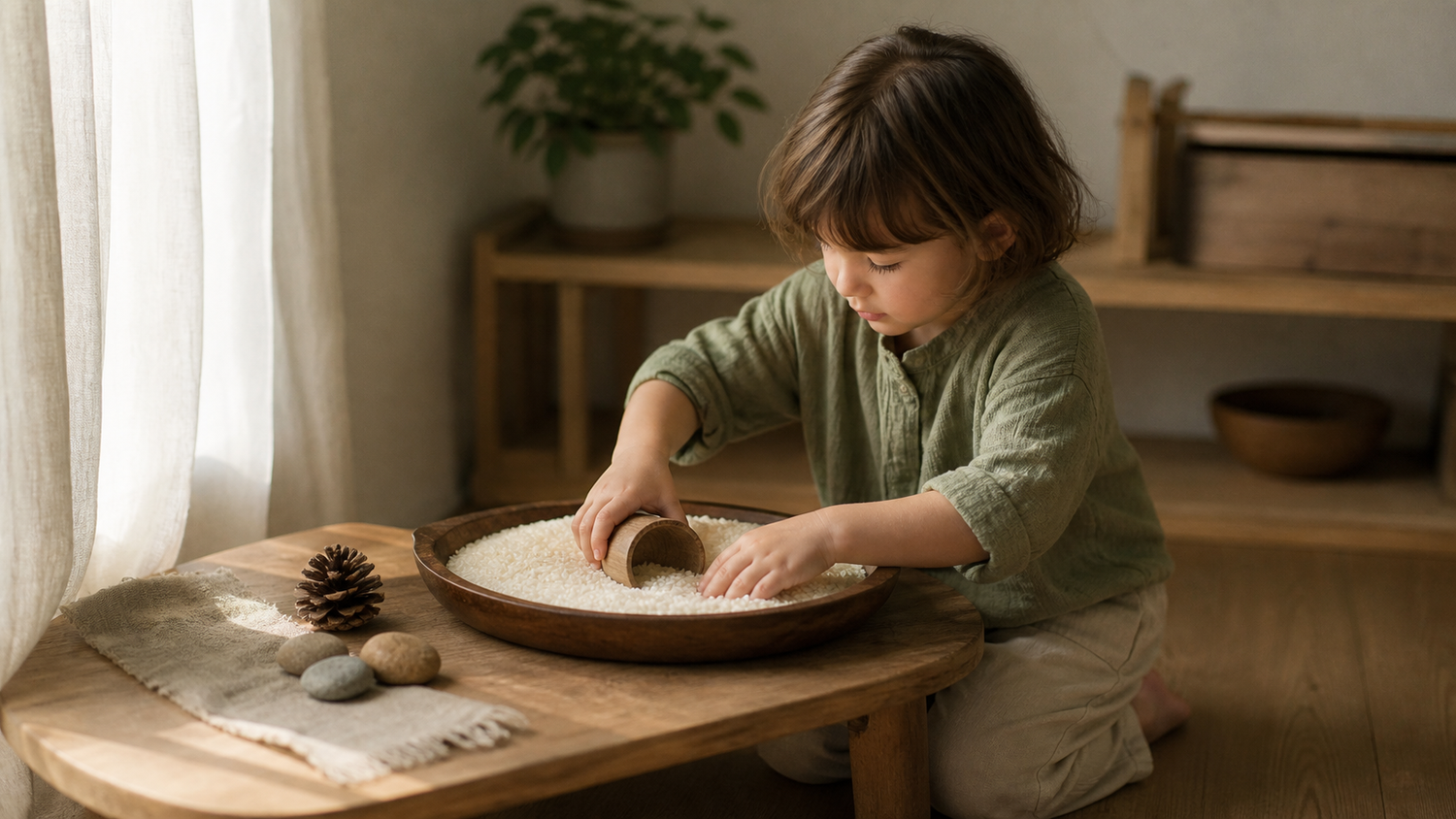
- Rice or lentil bin. A shallow box, a pound of rice, a spoon, and cups. Place a mat or bedsheet underneath, then cleanup is also taken care of.
- Barefoot path in the hallway. Four baking sheets or towels with different contents: chestnuts, cotton wool, sand, cold water. Close your eyes, walk over them, describe.
- Make your own playdough. Flour, salt, water, oil. Mixing it is already half the sensory experience.
- Scent jars. Small screw-top jars with cinnamon, coffee, lavender, orange peel. Smell and identify. Don't put anything in that your child might be allergic to.
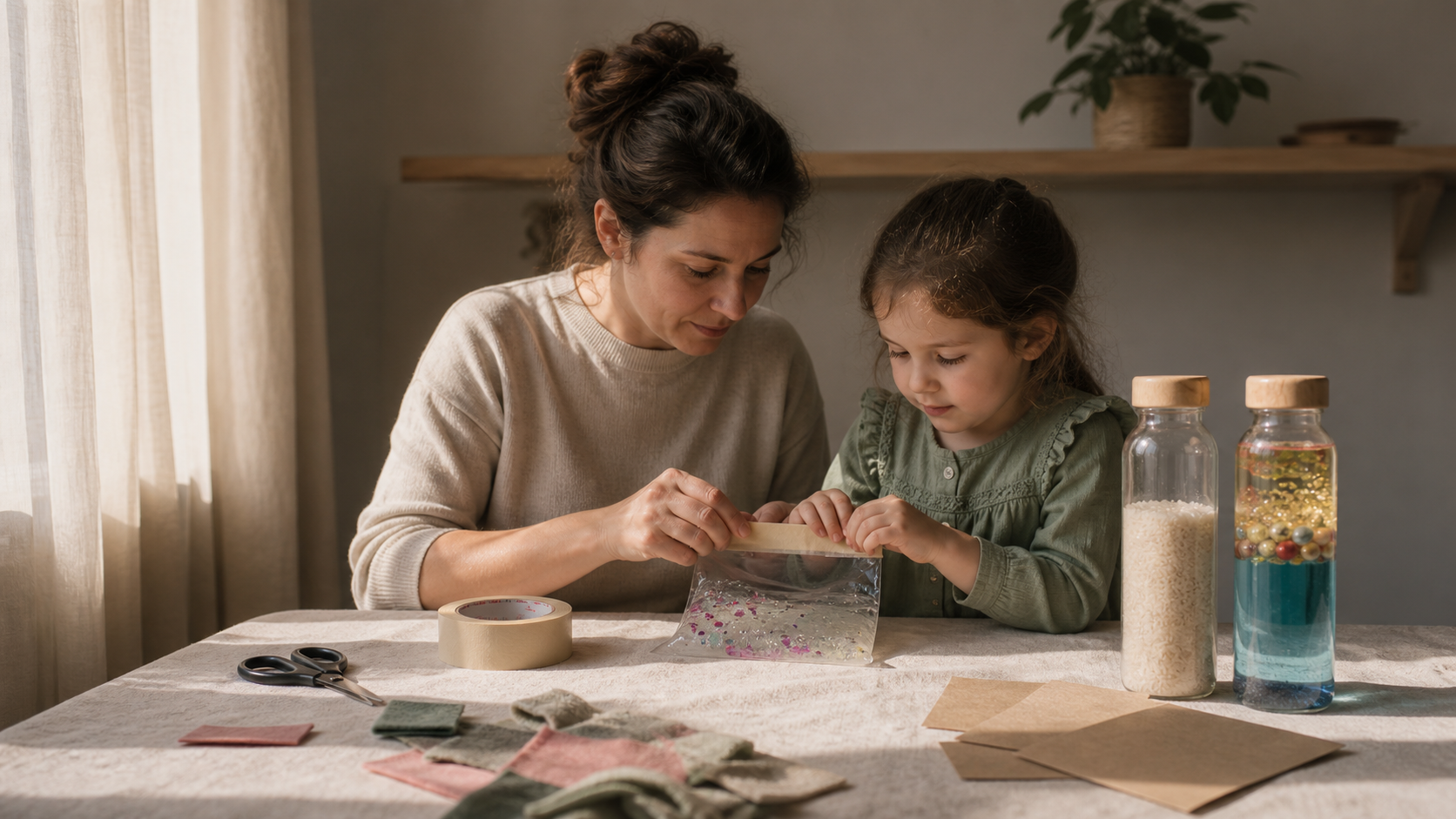
- Sound bottles. Fill empty bottles with rice, lentils, sand, paper clips, and seal them tightly. Listen for pairs – this is sensory for the ears.
- Ice blocks with a surprise. Freeze small figurines in water and free them with warm water, salt, and a paintbrush.
- Nature treasure chest. Take something from every walk: bark, feathers, smooth stones. The collection becomes its own tactile material over months.
If you want to think further in this direction: In our article on upcycled toys you will find more ideas to make new things from existing ones.
Sensory wall and accessories: is it worth it?
Sensory walls – boards with locks, zippers, gears, switches – look impressive and are often the most expensive item in this category.
An honest assessment, explicitly as a practical observation and not as a study result: They work best where children have to wait – hallways, waiting rooms, daycare corridors. At home, they often become part of the wall after a few weeks and are no longer looked at because each element has exactly one function. This is precisely the type of construction that the BIÖG describes as quickly boring.
If you still want one: Built yourself from real locks, an old doorknob, and a light switch, it is usually more appealing than the purchased version – and your child can help with the construction.
Safety: what to look out for when buying
Sensory toys are particularly likely to end up in the mouth, to be kneaded, sucked, and taken apart. This is why a second look is worthwhile here. In its guide to buying toys, the BIÖG (German Federal Centre for Health Education) lists several specific points:
- CE mark is mandatory, not a quality seal. "Only toys that comply with this standard and are marked with the CE mark may be sold in the EU." According to BIÖG, the GS mark ("Geprüfte Sicherheit" - Tested Safety) offers "more safety" because it involves independent testing.
- Small parts for children under 3. Toys must be "large enough that they cannot be swallowed and/or inhaled." In the sensory toy corner, this particularly concerns beads, water beads, small sound balls, and anything that can be pulled off.
- Volume. The institute's practical test is as simple as it is effective: Hold "toys that make noise or music directly to your ear. If it seems too loud there, it is not suitable for children's ears."
- Plastics. Look for "PVC-free" or "phthalate-free"; the BIÖG names PP, PE, or the "numbers 1, 2 or 4 to 6 in a triangle" as better alternatives.
- Wood. Prefer "unlacquered, waxed wood."
- Electricity. "Electrically operated toys may have a maximum voltage of 24 volts."
One point that is rarely mentioned in guides but counts in everyday life: homemade materials are not automatically safer. Dried beans, water beads, and small natural materials should not be within reach of children under three years old.
When stimuli are too much rather than too little
A misconception shapes this product category: that more sensory input is fundamentally better. For many children, the opposite is true.
In its guide, the BIÖG clearly states what children need to play: "Too many toys can overwhelm a child." The guide to the right toys adds that "overstuffed toy boxes and shelves tend to unsettle and overwhelm the child" – because there isn't enough time "to focus on one thing extensively." And for the schedule, the institute recommends "one, at most two fixed appointments per week."
One sentence from there is worth putting on the fridge: "It's okay to be bored sometimes; it's often the ground on which a new play idea grows!"
This applies even more strongly to highly sensitive children – and to children with an autism or ADHD diagnosis. What experience shows helps in practice is not more material, but:
- One thing at a time. Not the whole box, but one bowl.
- Control over the stimulus. Being allowed to start, stop, and repeat on their own.
- Allow repetition. The same sensory box for the twentieth time is not stagnation, but security.
- Rotation instead of acquisition. Put half away and swap it every few weeks. This feels like new toys without being new ones.
We have described in detail how you can recognize if your child is currently receiving too many stimuli in our guide on sensory overload in children.
Important: Sensory toys are not a therapeutic tool and do not replace professional assessment. If you have the impression that your child is consistently poorly processing sensory stimuli, talk to your pediatrician. Occupational therapy and early intervention are the established points of contact – they also work with sensory integration approaches.
The sensory channel almost always forgotten when shopping
In practice, sensory toys almost always mean: touch. Shelves full of textures, nubs, and surfaces. Hearing only appears as a side effect – as a rattle, squeaker, or ringing tone.
However, the auditory channel is special in one respect: it leaves the body free. A child can build, knead, or simply lie down while listening. No other sensory channel allows this as an aside.
| Sensory Channel | What appeals to it | Body involvement | Controllability of stimuli |
|---|---|---|---|
| Touch | Sand, playdough, water, sensory box | bound (hands) | yes, via material |
| Balance | Swing, balance board, roughhousing | fully engaged | limited |
| Sight | Screen, light effects | mostly still | difficult |
| Hearing | Stories, sound games, music | free | yes, via content and volume |
However, moderation also applies to hearing. The BIÖG recommends a maximum of 45 minutes of audio media per day for children aged 3 to 6, and up to 60 minutes for 6 to 9-year-olds. In comparison: for screen media, the recommendation is a maximum of 30 minutes (3-6 years) or 30 to 45 minutes in leisure time (6-9 years). For children under 3, the institute recommends a maximum of 30 minutes of audio – and "preferably no" screen media.
And a hectic audio drama with many effects can be just as overwhelming as a blinking sensory board. It depends on the pace and volume of the content, not just the medium.
How Ohrlaf fits into a low-stimulation play environment
Ohrlaf is a screen-free audio box: your child places a card on it, and the story starts. No display, no menu, no app on the device, no autoplay loop to the next episode.
According to the criteria above:
- One channel instead of many. Only listening – hands remain free for building, kneading, or painting.
- The child controls it themselves. Card on, card off. No adult has to take anything away.
- It stops on its own. The story ends instead of continuing indefinitely.
- Repetition without discussion. The same card for the twentieth time is simply possible.
Own recordings are created separately in the Ohrlaf Studio and then transferred to a card – your own voice, a bedtime ritual, an acoustic schedule for the morning. Some parents use this for recurring routines.
Conclusion
Sensory toys are neither a miracle cure nor a marketing trick. They are materials that appeal to the senses – and most of them are already in your kitchen, bathroom, and the woods behind your house.
What matters is not the quantity, but the openness: Can my child do something of their own with it, or does the product dictate everything? And is the stimulus delivered controllably – or just loudly?
If you're unsure, start small. A bowl of rice, a sensory box made from a shoebox, an afternoon with no appointments. You can find out how to bring more calm to your afternoon in our article on meaningful activities for children.
Frequently asked questions
What are sensory toys? Toys that specifically appeal to one or more senses – touch, hearing, sight, smell, taste, plus balance and body awareness. The term is not protected: a sack of chestnuts falls under it just as much as a bought sensory set.
How do sensory toys work? They offer the child targeted sensory experiences that they can classify and process. The Society for Sensory Integration according to Jean Ayres describes sensory integration as the neurological process by which sensory impressions are organized "so that a person can effectively use their body within the environment." So the crucial factor is not the quantity of stimuli, but that the child can sort them.
From what age are sensory toys suitable? Basically from infancy, because children explore their environment through their senses from the very beginning. What fits shifts with age: babies grasp and feel, toddlers pour and stack, from three years old, sensory play transitions into role-playing, schoolchildren like skill and rules.
For what age is Sensory Play suitable? For all ages – the activities just need to match the developmental stage. Safety is important: for children under three, small parts, water beads, and dried legumes should not be within reach, because, according to BIÖG, they must not be swallowed or inhaled.
What sensory ideas are there for children? Sensory box from a shoebox, rice bin, barefoot path from baking sheets, homemade playdough, scent jars, sound bottles, ice blocks with frozen figures, nature treasure chest. The BIÖG also mentions plastiline, clay, sand, finger paints, and natural materials like chestnuts, twigs, and shells for 3 to 6-year-olds.
What toys are pedagogically valuable? According to the BIÖG's criteria, good toys are safe, sturdy, durable, age-appropriate, and above all, versatile – they should be able to "be used and supplemented in ever new ways." The institute is critical of toys that turn the child into a "passive spectator" because they only need to be turned on.
Can sensory toys help with autism or ADHD? Sensory toys are not a therapeutic tool, and we deliberately make no claims about their effectiveness. Many parents report that clear structures, less material at once, and control over the stimuli make everyday life more relaxed. Whether and what is appropriate in individual cases should be discussed with a pediatrician or occupational therapist.
How many sensory toys does a child need? Fewer than the market suggests. The BIÖG warns that "too many toys can overwhelm a child" and states elsewhere that "overstuffed toy boxes and shelves" tend to make the child insecure. It has proven effective to put some away and swap them every few weeks.
Sources
- Federal Institute for Public Health (BIÖG), kindergesundheit-info.de: The Right Toys for Your Child — criteria for good toys, classification of electronic toys
- Federal Institute for Public Health (BIÖG): Buying Toys — CE and GS marks, small parts, volume, plastics, 24-volt limit
- Federal Institute for Public Health (BIÖG): What Children Need to Play — too many toys, busy schedules, boredom
- Federal Institute for Public Health (BIÖG): Games and Toys: 3–6 Years — material recommendations for this age group
- Federal Institute for Public Health (BIÖG): How Often and How Long Can Children Use Media? — all time specifications for audio and screen media
- Society for Sensory Integration according to Jean Ayres, Germany and International e. V.: What is Sensory Integration? — definition
- Professional Association of Pediatricians (BVKJ), kinderaerzte-im-netz.de: Perception Through the Senses — vestibular and proprioceptive system
Note on the factual basis: All specific figures, quotes, and recommendations in this article are derived from the sources linked above and are directly linked within the text. Statements without a source reference — such as the age table, crafting ideas, and the classification of sensory walls — are expressly marked as practical observations and should not be interpreted as study results. This article contains no claims of efficacy or healing; for questions regarding your child's sensory processing, a pediatrician's office or an occupational therapist is the right address.


Leave a comment
This site is protected by hCaptcha and the hCaptcha Privacy Policy and Terms of Service apply.