
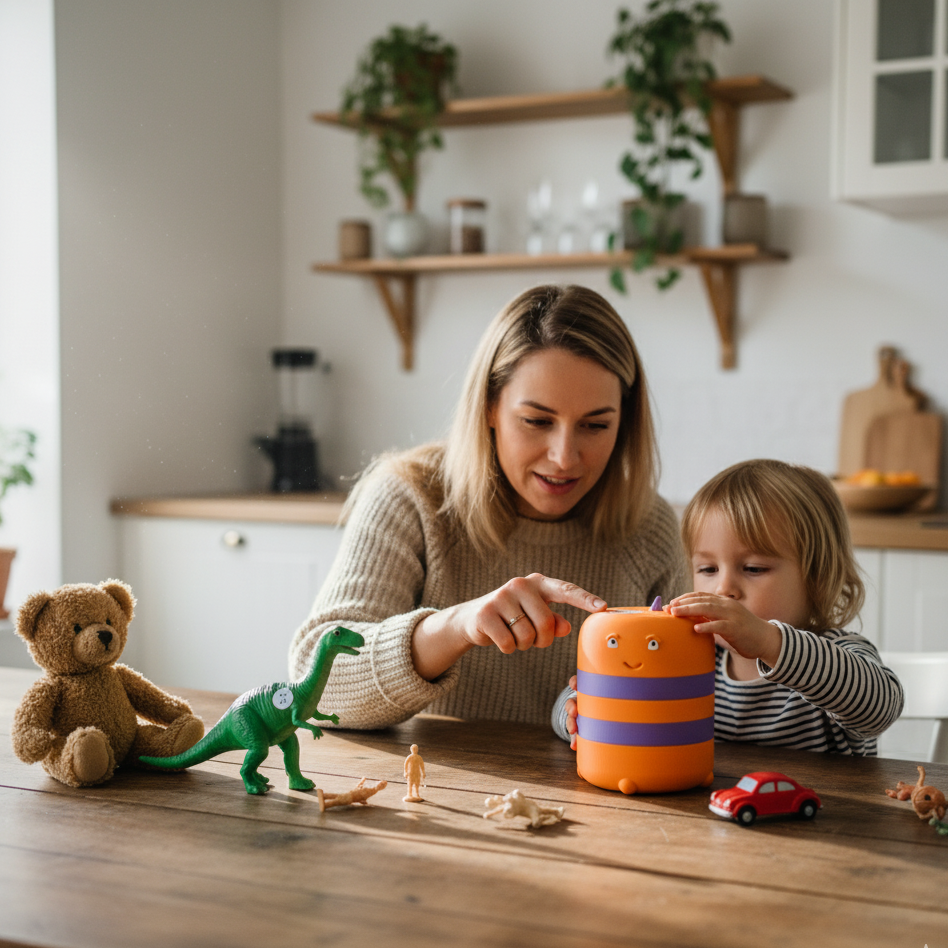
Declutter toys and ignite imagination at the same time? It's possible! With clever upcycling, forgotten items become beloved toys again. Here you'll learn how to not only repair old toys but also transform them into new, interactive audio adventures – sustainably, creatively, and completely screen-free.
The Problem: Too Many Old Toys, Too Little Imagination
Does this sound familiar: the children's room is full of figures, cars, and cuddly toys – yet you still hear, "I'm bored"? Many toys become meaningless over time, not because they are broken, but because the story behind them is missing. Without new impulses, they end up in boxes, drawers, or, in the worst case, the trash.
For parents, this is frustrating: money is tied up, space is lacking, and truly sustainable solutions are rare. Classic craft projects are nice, but they often only change the appearance. What children truly lack is interaction, magic, story – a trigger that re-engages their imagination.
Upcycling Toys: Crafting, Repainting, Repairing
Of course, classic upcycling is worthwhile: gluing, repairing, repainting – all of this extends the lifespan of toys. Projects like homemade rattles, refurbished wooden blocks, or newly sewn doll clothes are great starting points. However, they usually remain physical: pretty for the shelf, but not always consistently exciting in everyday play.
What is often missing is a new purpose for play. A car is and remains a car. A pirate remains just a figure. This is exactly where the idea of digital upcycling comes in: old things get a second story – and children take an active role as directors.
Digital Upcycling with RFID: Why Throw Away When Your Child Can Give Their Toy a Second Story?
The idea is simple and child-friendly: small adhesive tags with RFID (tiny radio chips) are attached to toys, figures, or everyday objects. The Audio Toy Ohrlaf recognizes each tag without contact – and starts corresponding audio stories, games, or sounds. This way, an old dinosaur suddenly becomes a volcano guide, a wooden car a race director, and a teddy bear a storyteller.
The best part: It requires no screen, no app, and no Wi-Fi (only for updates). Children tap, listen, decide – and are right in the middle of it. For parents, this means fewer new purchases, more play value, and more peace in everyday life.
Ohrlaf: Screen-Free Play & Learn
Ohrlaf is an interactive, screen-free audio toy with real voices, music, and sounds. It promotes listening, concentration, language comprehension, and imagination – all without an app. Content grows with your child: new card sets, creative games, sound guessing, learning worlds. Ideal for ages 3–9, for playing together or alone. Start with the Ohrlaf Starter Set and expand as needed.
Ohrlaf Studio: Personalize Toys Instead of Replacing Them
In the Ohrlaf Studio (Beta), you create stories, games, and small missions – alone, with your child, or at daycare. Each created content can be linked to a tag. This turns your existing toy into a key to a new audio world.
- "This figure will be the hero of your adventure."
- "This car starts a sound race."
- "This stuffed animal will read you tonight's bedtime chapter."
No limitation by prefabricated accessories: your child decides what becomes important. This is true upcycling – revival instead of repurchase.
5 Upcycling Ideas That Will Really Make Toys Played With Again with Ohrlaf
1) The Old Teddy Gets His Own Voice
Play Effect: When your child holds the teddy bear to Ohrlaf, the teddy speaks in a familiar voice, tells jokes, or guides them through a bedtime story.
Educational Value: Emotional bonding, language comprehension, listening, facilitating transitions (e.g., bedtime routine).
How to do it:
- Discreetly attach a creative tag to the paw.
- Record a few sentences in your voice in the Ohrlaf Studio (greeting, favorite joke, bedtime story).
- Link the recording and the tag – and the talking teddy is ready.
2) The Playmobil Pirate Becomes the Heroine of a Self-Made Audio Play
Play Effect: Each touch starts the next chapter of a choose-your-own-adventure: "Left cove or right cave?"
Educational Value: Narrative thinking, problem-solving, impulse control (listen first, then act).
How to do it:
- Attach the tag to the figure (e.g., on the cape or back).
- Build a short, branching story in the studio (2–3 decisions are enough).
- Add optional sound effects (sea, seagulls, stomping).
3) The Plastic Dinosaur Explains the World of Volcanoes
Play Effect: Tap – and the dinosaur explains lava, craters, and volcanic eruptions with real sounds.
Educational Value: Factual knowledge, vocabulary, auditory learning.
How to do it:
- Attach the tag to the belly or back.
- Record short informational snippets or select them from a learning set.
- Add a mini-quiz ("What color is lava?").
4) The LEGO Car Starts a Real Race with Sound Effects
Play Effect: Touch – start signal, engine sound, commentary. After a lap, there's a cheering sound.
Educational Value: Counting, sense of time, understanding rules, motivation through acoustic feedback.
How to do it:
- Place the tag on the underside of the car.
- Configure the start countdown, lap trigger, and finish line sound in the studio.
- Optional: Measure time and record it in a "leaderboard" (audio announcement).
5) The Wooden Figure Becomes a Quizmaster
Play Effect: Each touch starts a new question ("Which animal says 'Mäh'?") or a sound guessing game.
Educational Value: Language promotion, concentration, auditory discrimination, memory training.
How to do it:
- Attach the tag to the back of the wooden figure.
- Create questions/answers as audio in the studio (3–5 are sufficient).
- For correct answers, Ohrlaf plays a short "Correct!" signal.
Checklist: How to Start Upcycling Toys Today
- Unearth treasures: Choose 5–7 old favorite items (figure, car, stuffed animal, building block).
- Define functions: Story? Quiz? Sound game? Learning info?
- Attach creative tags – as discreetly and securely as possible.
- Create content in the Ohrlaf Studio or choose from existing sets.
- Test briefly, then present the "new" games to your child – the stage is yours!
Why This Is More Sustainable Than Any Craft Project
- No New Purchases: You use existing items – and save plastic, packaging, and transport emissions.
- No Waste: Toys stay in circulation and become relevant again.
- Appreciation Instead of Consumption: Your child learns: things are valuable when you give them meaning.
- Creativity & Media Literacy: Building stories, assigning sounds, inventing rules – active instead of passive.
- Routines & Calm: Audio instead of screen – good for focus and family atmosphere.
Future Outlook – A Sustainable Play World, Game by Game
The more families share their content, the greater the variety of ideas becomes. Community contributions inspire – from daycare to grandparents who record a personal reading voice. This creates a play world that grows with your child, connects generations, and conserves resources.
Conclusion
Upcycling doesn't have to look like a crafting session. With Ohrlaf, it becomes an experience: old toys get new roles, children become storytellers – and you reduce consumption without sacrificing play fun. Start your first upcycling story in the Ohrlaf Studio and secure suitable creative tags for a quick start.
Further Reading
FAQ
How does toy upcycling with RFID tags work?
You attach small tags to figures, cars, or stuffed animals. Ohrlaf recognizes each tag contactlessly and starts the linked audio action: story, sound guessing, quiz, or learning info. This gives old toys new meaning – without an app or screen.
Does my child need a tablet or Wi-Fi for this?
No. Ohrlaf is a screen-free audio toy. It works offline; only for updates are internet and an adult required.
What age is this suitable for?
Recommended: approximately 3–9 years. Younger children benefit from sounds and simple stories, older ones from choose-your-own-adventures, quizzes, and their own recordings.
What do I need to get started?
An Ohrlaf Starter Set, some creative tags, and access to the Ohrlaf Studio to create or personalize content.
Is this really sustainable?
Yes – you continue to use existing items, avoid new purchases, and simultaneously promote creativity and language development. This way, toys stay in use longer and become emotionally more valuable.


Leave a comment
This site is protected by hCaptcha and the hCaptcha Privacy Policy and Terms of Service apply.