
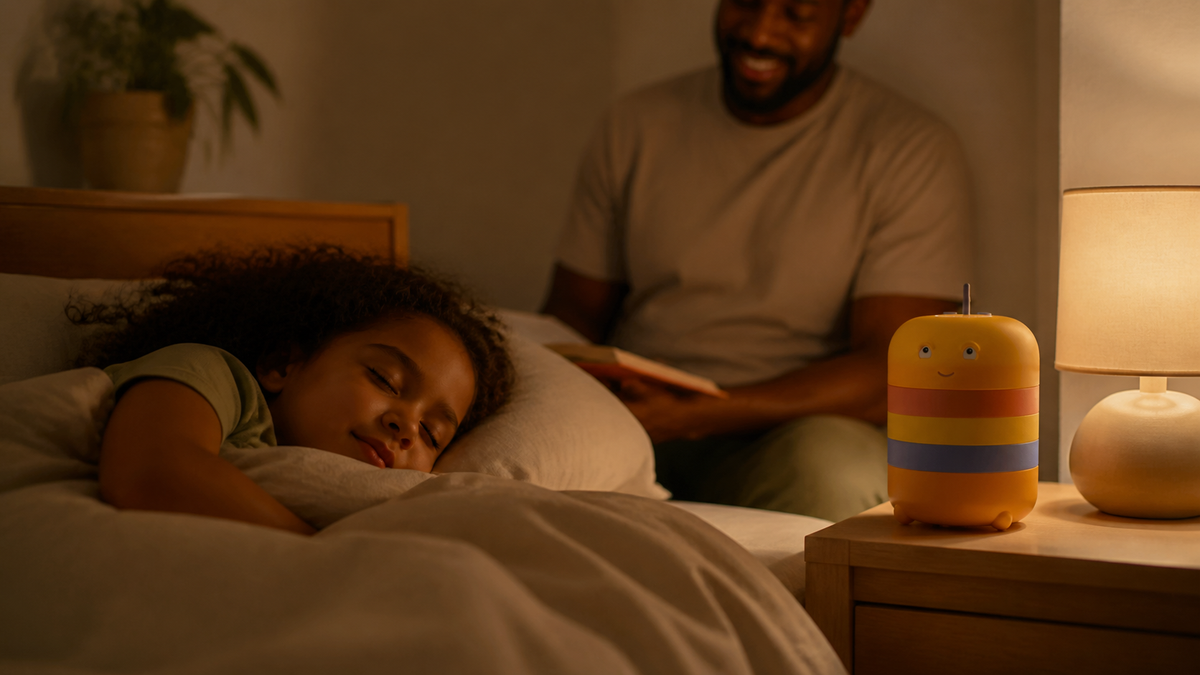
It's 8:15 PM. The story is over, the lights are out – and your child is wide awake, talking about kindergarten, thirsty, and urgently needs the other cuddly blanket.
The story wasn't the problem. The problem usually lies in the hour before.
This guide shows you what an evening ritual that works looks like: what official recommendations say about timing and routine, what distinguishes a good bedtime story from an exciting one, where to find free bedtime stories – and when reading aloud and when listening is the better choice.
What a bedtime ritual should achieve
A ritual is not an extra program for good days. It is the signal that tells your child that the day is ending now – the same every evening, in the same order.
The Federal Institute for Public Health (BIÖG) explicitly recommends a "regular bedtime ritual that can include elements such as singing, reading aloud, or listening to music." The institute names the last half hour before falling asleep as the timeframe – and advises consistently adhering to the set bedtime.
Remarkably, reading aloud and listening are placed on equal footing there. It's less about the perfect story and more about the reliability of the routine.
And something else that according to BIÖG is part of it but often overlooked: an open ear for what the child has on their mind. The child should feel that they can come with their worries and fears at any time. This is why cuddle time before bed is the most talkative fifteen minutes of the day for many children – even if they sometimes use it to delay bedtime.
How much sleep your child actually needs
Before we talk about stories, it's worth looking at the clock. Many sleep problems are simply time problems: the child goes to bed too early or too late.
The BIÖG provides the following average values for sleep requirements within 24 hours:
| Age | Sleep requirement per 24 hours |
|---|---|
| 2 years | 13 hours |
| 3 years | 12.5 hours |
| 4 years | 11.8 hours |
| 5 years | 11.4 hours |
| 6 years | 11 hours |
The most important sentence about this is right next to it: deviations of up to two hours are completely normal. According to BIÖG, how much sleep is needed and how it is distributed throughout the day and night "varies greatly from child to child."
Two hours of leeway is a lot. What this means for your own evening, however, is our interpretation and not a recommendation from the institute: If your five-year-old child lies awake in bed for 45 minutes in the evening, a possible explanation is not "they can't fall asleep," but "they are not yet tired." Going to bed half an hour later is then worth a try before you tinker with the story.
The last hour decides
Here lies the lever that achieves the most in everyday life – and requires the least effort.
The BIÖG writes about sleep prerequisites: "One hour before falling asleep, screen media such as TV, game consoles, tablets, or smartphones should be turned off." In the bedtime tips, this is extended somewhat: "In the last hour before bedtime, strong stimuli such as wild romping and playing, but especially screen media such as television or video games, should be avoided."
So wild romping is listed alongside the tablet. This is often the more uncomfortable realization in everyday life – a pillow fight at 7:30 PM is just as much a wake-up call as an episode of Fireman Sam.
What the institute also mentions about the sleep environment: light and noise can sensitively disturb children's sleep, the room temperature should be around 18 degrees Celsius, and there should be a good hour between dinner and bedtime – lavish and heavy meals in the evening make it harder to fall asleep.
If your child has particular difficulty winding down in the evening after busy days, it's also worth looking at everything that has happened during the day. We have described this in detail in the article on sensory overload in children – the evening meltdown often has to do with the afternoon, not the ritual.
What makes a good bedtime story
Not every children's story is suitable for 7:45 PM. The following classification is an observation from practice, not a study result – but it aligns with what the BIÖG writes about strong stimuli in the last hour.
It's short. Five to ten minutes are plenty for younger children. A long story keeps them awake instead of making them tired.
It's self-contained. No cliffhangers, no open questions, no "and then what happens?". What remains unresolved continues to work in the mind.
It has few characters. Two, three characters. Anything beyond that requires sorting work.
It's familiar. The same story for the thirtieth time is not a step backward. Predictability is an advantage when falling asleep, not boredom.
It ends quietly. Ideally with an image that lingers: someone falls asleep, it becomes quiet, the lights go out.
What typically backfires: detective series, scary stories, and anything with a chase. Such formats are great – in the afternoon. We have sorted which audio formats are suitable for which age in the article on children's audio plays.
Reading aloud or listening?
Both are listed side-by-side in the BIÖG recommendations – but in everyday life, the two approaches differ significantly. The following comparison is a classification based on practical characteristics, not an evaluation or a test.
| Reading aloud yourself | Listening to a story | |
|---|---|---|
| Closeness and conversation | Core element – questions possible at any time | does not occur |
| Pace | You adapt it to the child | fixed |
| When you are exhausted yourself | strenuous | still works |
| Second child in the room | difficult with a large age gap | possible for both at the same time |
| In case of illness or hoarseness | cancelled | not cancelled |
| Clear ending | yes, you close the book | only if the device does not automatically play the next track |
The most honest approach is a mix. Reading aloud is more valuable – there's little doubt about that, and it's the recommendation that always comes first. But there are evenings when it's not possible: two children, an exhausted adult, a sore throat, a late shift. An audio story on these evenings is not a substitute for reading aloud on the others – it keeps the ritual going instead of letting it lapse.
The Stiftung Lesen has surveyed how often children are read to in Germany. The Vorlesemonitor 2024 surveyed 815 parents of children aged 1 to 8 years. The result: 32.3 percent of these children are rarely or never read to, 18 percent never. Another finding from the same survey is striking – 74 percent of parents who were read to as children read to their own children several times a week. Reading aloud is apparently passed on.
Free bedtime stories: where it's worth looking
You don't need a subscription for bedtime stories. The highest quality offerings in Germany are public and therefore free.
Ohrenbär is the ARD podcast from rbb and NDR – daily audio stories for children, sorted by age recommendation from 4 and from 6 years. The episodes are about 15 minutes long and are available for free as a podcast and MP3 download. For an evening ritual, it's particularly practical that the stories appear chapter by chapter: one episode per evening, with a clear ending.
ARD Sounds bundles ARD's children's offerings and features its own category for bedtime stories – including "Betthupferl" and "Unser Sandmännchen." The offering is free and can be used without a subscription; there is an app for Android and iOS.
A time-saving tip: Many collections of bedtime stories are aimed at adults, not children. The ARD Sounds bedtime collection, for example, consists predominantly of classic literature for adult listeners. If you are looking for children's stories, it's worth looking in the children's section instead of the bedtime section.
Inventing your own stories
One of the most common search queries on this topic is roughly: What do I tell if I can't think of anything? The following approaches are practical tips, not recommendations from a specialized source – but they work because they take away the pressure to invent.
The day in reverse. Tell your child's day as a story, from back to front, in a calm tone. This is not fantasy, it's sorting – and children surprisingly love to listen to themselves.
Always the same character. An animal that experiences something small every evening. The framework remains, only a small detail changes. This saves invention work and creates recognition.
The journey through the room. Slowly describe what is in the room – the lamp, the shelf, the ceiling. Sounds trivial, but has a calming effect on many children.
The borrowed ending. Take a book you know and only continue the last five minutes of it. No new world, no new arc of suspense.
And if nothing works: a familiar story again. Repetition is expressly allowed for falling asleep.
If it still doesn't work
Some children take a long time to fall asleep, wake up frequently at night, or simply can't settle down in the evening – for weeks, not just after a birthday party.
Important: This text is not a substitute for medical or therapeutic assessment. If your child sleeps significantly worse for an extended period, appears noticeably exhausted during the day, or if bedtime regularly becomes a burden for the whole family, speak with your pediatrician. For questions about sensory processing, occupational therapy and early intervention are established points of contact. A conversation is not an alarm signal – those who look closely early on have more options.
How Ohrlaf fits into the evening ritual
Ohrlaf is a screen-free audio box for children aged approximately 3 to 9: your child places a card on it, and the story starts. No display, no menu on the device, no app to play, no advertising.
Measured against the points in this article:
- No screen in the last hour. The recommendation to avoid screen media an hour before bed remains untouched – there's no screen needed to start.
- It ends. The story stops instead of automatically playing the next episode. This eliminates the moment when someone has to take something away.
- The same thing every time is easy. The same card, the same routine, every evening. Exactly what a ritual is all about.
- Your own voice. Your own recordings are created separately in the Ohrlaf Studio and then transferred to a card – a self-narrated bedtime story that plays even when you're not there one evening. Some parents use this precisely for that purpose.
This does not replace reading aloud. It's the option for evenings when reading aloud is not possible.
Conclusion
The story is the nice part of the evening ritual – but rarely the decisive one. What makes the difference are three unspectacular things: a bedtime that matches the actual sleep needs, a quiet last hour without screens and wild romping, and a routine that is the same every evening.
And if your child wants the same story for the fortieth time: that's not a sign of lack of imagination. It's exactly what a ritual should be.
Further ideas for calm afternoons that make the evening easier can be found in the article on meaningful activities for children.
Frequently asked questions
What kind of stories are needed for falling asleep? Short, self-contained stories with few characters and a quiet ending. Five to ten minutes are sufficient for younger children. Suspense, cliffhangers, and scary elements are better suited for the afternoon. The BIÖG recommends a regular ritual for the last half hour, which may include elements such as singing, reading aloud, or listening to music.
What free bedtime stories are available? The strongest free sources are public-service broadcasters. Ohrenbär from rbb and NDR offers daily audio stories for children aged 4 and up, and 6 and up, approximately 15 minutes long, available for free as a podcast and MP3 download. ARD Sounds has its own category for bedtime stories in the children's section, including "Betthupferl" and "Unser Sandmännchen."
Which audio plays are good for falling asleep? Those that start calmly, end calmly, and do not automatically transition to the next episode. Detective and horror series are usually unsuitable for the evening, even if children request them. A categorization by age group can be found in our article on children's audio plays.
What stories can I invent for falling asleep? Four approaches that work in everyday life: tell the child's day backward, always the same character with a small new event, a slow description of the room, or continuing the last five minutes of a familiar book. These are practical tips, not recommendations from a specialized source – but they take away the pressure to invent.
How much sleep does my child need? The BIÖG states the following average values per 24 hours: 13 hours at 2 years, 12.5 hours at 3 years, 11.8 hours at 4 years, 11.4 hours at 5 years, and 11 hours at 6 years. Important to note: deviations of up to two hours are completely normal, according to the institute.
When should screens be off in the evening? The BIÖG recommends that screen media be turned off one hour before falling asleep. In the same hour, according to the institute, other strong stimuli should also be avoided – explicitly mentioning wild romping and playing.
Is reading aloud better than an audio story? Reading aloud offers something that a recording cannot: closeness, asking questions, a pace that adapts to your child. However, the BIÖG lists reading aloud and listening to music as equally valid ritual elements. In practice, this means: read aloud when possible – and on evenings when it's not possible, an audio story maintains the ritual instead of letting it lapse.
Sources
- Bundesinstitut für Öffentliche Gesundheit (BIÖG), kindergesundheit-info.de: Bedtime tips — Ritual with singing, reading aloud, or listening to music; last half hour; fixed bedtime; no strong stimuli in the last hour
- Bundesinstitut für Öffentliche Gesundheit (BIÖG): About sleep needs and duration — all hourly figures in the sleep needs table, note on deviations of up to two hours
Note on the factual basis: All specific figures, quotes, and recommendations in this article originate from the sources linked above and are directly linked in the text. Statements without source attribution – such as the characteristics of a good bedtime story, the comparison of reading aloud and listening, and the ideas for self-invention – are explicitly marked as practical observation and should not be read as study results. This article contains no claims of efficacy or healing for sleep problems. For persistent sleep difficulties, the pediatrician's office is the right place to go.

Leave a comment
This site is protected by hCaptcha and the hCaptcha Privacy Policy and Terms of Service apply.