
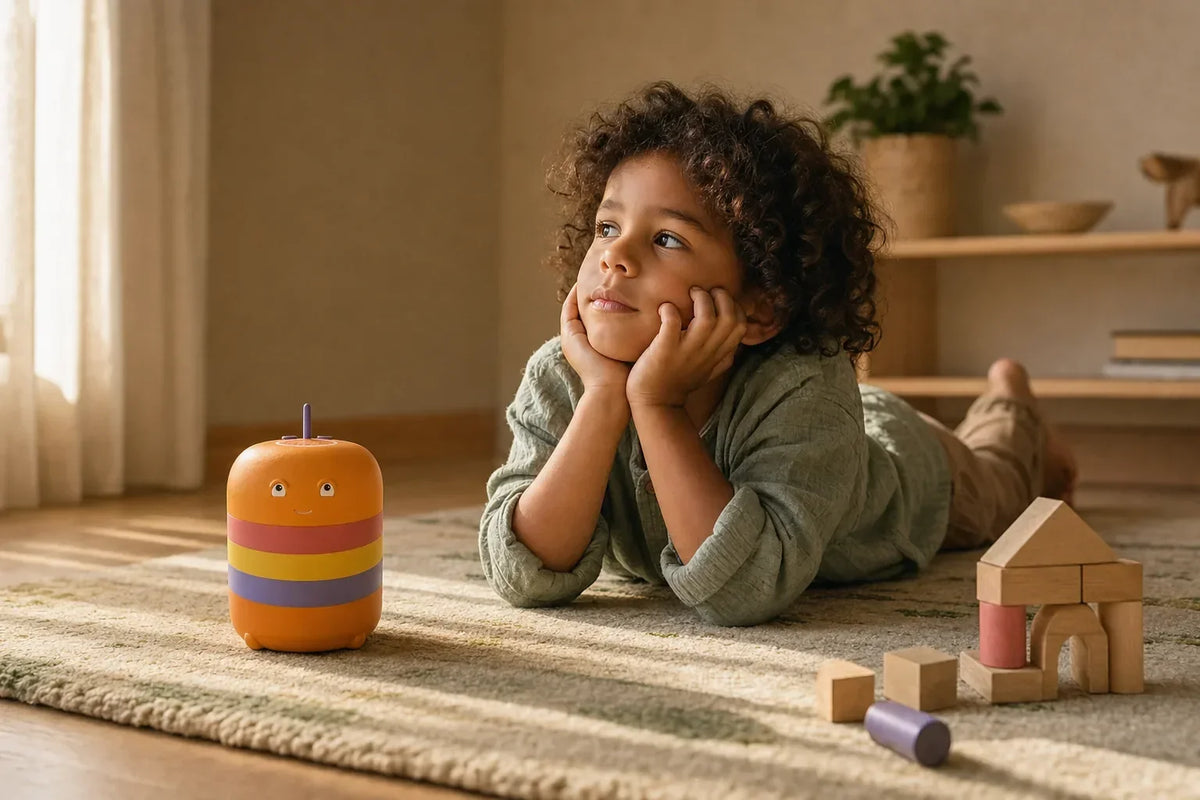
You're looking for an audio play for your child and you land on a list of 200 titles. All of them say "ages 3 and up." Some are eight minutes long, others an hour and a half. And somewhere in between is the episode that kept your child awake all night.
The real problem is rarely the selection. It's the lack of sorting. This guide categorizes children's audio plays by age and format, shows you where to get high-quality audio plays for free, and explains how to tell when an audio play is too much – even if your child is still asking for "just one more episode!"
Audio plays are a part of children's daily lives
This can be proven with figures. The miniKIM Study 2023 by the Media Education Research Association Southwest examined the media habits of two- to five-year-olds: 37 percent of these children listen to audio plays, audiobooks, or podcasts (almost) every day, with another 32 percent listening at least once a week or several times a week. Among four- to five-year-olds, daily (or almost daily) use is slightly higher at 40 percent than among two- to three-year-olds at 35 percent.
This trend continues with older children: According to the KIM Study 2024, 53 percent of 6- to 13-year-olds listen to audiobooks or audio plays at least occasionally, and 31 percent at least once a week. Music players specifically for children – the study mentions Toniebox and Hörbert – are found in about a third of households, and "one in five children has a music player specifically for children" in their own room.
It's interesting to see when they listen. The miniKIM study notes: "Audio media are primarily used during play (42%), for relaxation in the afternoon (39%), and at bedtime in the evening (38%)." This is precisely where the difference from screens lies – listening happens in the background, while hands remain free.
What makes a good children's audio play
Before we talk about age, here are three criteria that apply across all age groups.
It matches the developmental stage, not the number on the packaging. The Medienkindergarten Wien – an initiative of the Vienna Education Administration – states that suitability depends less on age and more on "personal developmental stage": concentration span, attention, and previous listening experience count more than the age printed on the product.
It doesn't overwhelm. The Federal Institute for Public Health (BIÖG) clearly states: "Children's audio media can frighten, scare, or disturb if they are not age-appropriate." According to the BIÖG, younger preschoolers and elementary school children only perceive the parts of the plot that they understand – older children can grasp longer audio plays, comprehend characters, and evaluate stories.
You know it. The most practical tip from the BIÖG's everyday tips takes five minutes: "It's best to briefly listen to the new audio story before giving it to your child."
When audio plays are suitable, the BIÖG describes their benefits as follows: They promote language development – through "sound and noise effects, background sounds, music, or changes in speaking voices" –, support vocabulary building, and stimulate imagination and concentrated listening.
Children's audio plays for ages 3 and up
At this age, length is the decisive criterion. A three-year-old rarely follows a 60-minute plot – they follow a scene.
What usually works at this age:
- Short, self-contained stories instead of series with an overarching plot across multiple episodes
- Familiar everyday worlds: farm, daycare, family, animals
- Few characters and clearly distinguishable voices
- Calm pace, few effects, no cliffhangers
- Repetition: The same story for the twentieth time is not a step backward at this age, but a source of security
Public broadcasting offerings also focus on this: The BIÖG, in its overview of audio media, mentions the OHRKA portal for ages 3 and up, and the Radio Ohrenspitz channel for ages 4 and up.
What, from experience, quickly goes wrong in this age group: scary elements, loud action scenes, and episodes that end with an unresolved conflict. This is a practical observation, not a study result – but it aligns with what the BIÖG writes about non-age-appropriate audio media.
Children's audio plays for ages 5 and up, and 6 and up
Between five and six, a lot happens on the listening front. Children can follow longer narratives, remember characters across episodes, and start asking for series.
Typical for this stage:
- Series with recurring characters – the appeal lies in recognition
- First suspense arcs, but with reliable resolutions at the end of the episode
- Educational formats that explain rather than just tell stories
- Longer runtimes of about 20 to 40 minutes
Two free resources are particularly relevant here: ARD Sounds features "Ohrenbär" as a daily audio story for children between 4 and 8 years old – with over 600 episodes in the archive. At OHRKA, the category for adventure stories and children's detective stories starts at age 5.
Children's audio plays for ages 8 and up (and 10 and up)
From elementary school age, interest shifts towards suspense, investigation, and morally ambiguous characters. Detective series dominate – it's no coincidence that the KIM Study 2024 consistently lists classics like "The Three Investigators", "TKKG", and "Bibi and Tina" in the top positions for decades.
Here, it's worth considering two things:
- The dose of suspense. What an eight-year-old enjoys might be too much for a six-year-old in the same room. With siblings, the audio play is rarely for just one child.
- The end of the day. Crime and horror series are often great for the afternoon, but rarely suitable for the half-hour before bedtime.
OHRKA further categorizes by age at this stage: literary classics as audio plays for ages 8 and up, and more complex narratives for ages 12 and up. The BIÖG also refers to the Kakadu radio channel for children aged 6 to 12.
Age groups at a glance
The information on length and characteristics is a practical classification and not a developmental norm – children differ greatly here. The age recommendations in the right column come from the linked sources.
| Age | Typical Length | What usually works | Documented age recommendations from sources |
|---|---|---|---|
| 3–4 years | 5–15 min. | Self-contained everyday stories, few characters, calm pace | OHRKA from 3, Radio Ohrenspitz from 4 (BIÖG) |
| 5–6 years | 15–30 min. | First series, mild suspense with resolution, educational formats | Ohrenbär for 4–8 years (ARD Sounds); OHRKA adventures from 5 |
| 7–9 years | 30–60 min. | Detective and adventure series, episodes with plot arcs | Kakadu for 6–12 years (BIÖG); OHRKA classics from 8 |
Free children's audio plays: where it's really worth it
The good news for anyone who doesn't want another subscription: The highest quality children's audio plays in Germany are largely free, because they are produced by public broadcasters or non-profit organizations.
ARD Sounds bundles the ARD's children's offerings – audio plays, educational podcasts, and bedtime stories, including Ohrenbär, CheckPod with Checker Tobi, and Kakadu from Deutschlandfunk Kultur. The content is free and accessible without a subscription.
OHRKA is a non-profit audio media network that explicitly advertises "free and ad-free." According to their own statements, over 150 productions with more than 100 hours of content are available, sorted by age recommendations from 3, 5, 8, and 12 years – fairy tales, adventures, children's detective stories, and literary classics, narrated by well-known voices. The productions can be downloaded for private and educational use.
These two sources largely cover the age range of 3 to 9. You don't need a subscription for them.
Children's audio plays on YouTube and Spotify
Both methods work technically – but they differ in one point that matters in everyday life: how an audio session ends.
The following comparison is a classification along the characteristics of the respective playback methods, not a test or evaluation of individual providers:
| YouTube | Streaming app on mobile | Audio box / CD player | |
|---|---|---|---|
| Screen in use | yes | yes, at least when starting | no |
| Who starts and stops | usually an adult or autoplay | usually an adult | the child itself |
| What happens after the end | next video plays automatically | next track in playlist | Silence |
| Advertising possible | yes | depending on plan | no |
| Age filtering | limited | via curated playlists | via selection on the shelf |
For the afternoon, this doesn't mean "YouTube is bad." It means: On YouTube, the decision of when to stop is taken out of the child's hands and given to an algorithm. If your child listens via a screen, it's worth pre-setting the playlist and turning off autoplay.
And another point that is important when listening with headphones: The BIÖG recommends in its FAQ on children's headphones that the volume "should be limited to a maximum of 75 dB" and can be lowered by the child, but not increased. Headphone time should "not exceed 40 minutes per day in total." The institute advises against in-ear headphones for younger children. The simplest test is also listed there: If you can hear the audio story, it's probably too loud.
How much listening time per day is acceptable?
There are specific guidelines here. The BIÖG recommends for audio media:
| Age | Audio Media | Screen Media |
|---|---|---|
| under 3 years | max. 30 minutes | "preferably not at all" |
| 3–6 years | max. 45 minutes | max. 30 minutes combined |
| 6–9 years | max. 60 minutes | 30–45 minutes in leisure time |
Remarkable here is the ratio: Listening consistently gets more leeway in these recommendations than viewing. The institute does not give a reason for the difference – the obvious explanation, that only one sensory channel is used when listening and the body remains free, is our interpretation.
For comparison with reality: According to miniKIM 2023, toddlers spend an average of 38 minutes per day with a music box (girls 43, boys 34 minutes). The average is thus almost exactly within the recommended range – which conversely means that there are significant outliers upwards.
When audio plays overwhelm
Audio plays are considered a harmless medium. This is true compared to screens – but "harmless" is not the same as "arbitrary."
Three points where it can go wrong in everyday life:
Constant background noise. The BIÖG explicitly advises: "Ensure that audio media do not become constant 'background noise' in the children's room. Your child should really be listening." An audio play that has been running in the background for two hours while building and drawing is no longer listening – it's noise with a plot.
The wrong age. As quoted above: non-age-appropriate audio media can frighten or disturb children. With siblings, this often happens incidentally, because the older child sets the tone.
Overloaded sensory input. After daycare or school, many children's sensory input is already full. An exciting audio play on top can then trigger the overload that it was actually supposed to mitigate. How to recognize this is described in detail in our article on sensory overload in children.
A sentence that is often overlooked in the discussion is found in the Medienkindergarten Wien: Audio plays should not replace reading aloud, because they lack "the exchange with a trusted person and the possibility of asking questions." The audio play is a supplement to reading aloud, not a substitute.
Important: This text is not a substitute for medical or therapeutic assessment. If your child regularly reacts very strongly to sounds and stories, appears persistently overwhelmed, or you suspect they have hearing difficulties, speak to your pediatrician. For questions about sensory processing, occupational therapy and early intervention are the established points of contact.
Integrating audio plays wisely into the day
Three situations where listening generally works particularly well in family life – fitting the usage contexts identified by the miniKIM study (playing, relaxing in the afternoon, falling asleep):
- While building and drawing. Hands are busy, the story plays in the background. How this can be combined with other materials can be found in our article on sensory toys.
- As a buffer zone after daycare. A short, familiar episode in a quiet room – no questions, no agenda. Further ideas for calm afternoons can be found in the article on meaningful activities for children.
- As a bedtime ritual. Here, the rule is: always the same, always calm, always with a defined end. Crime stories belong in the afternoon.
How Ohrlaf fits in
Ohrlaf is a screen-free audio box for children aged approximately 3 to 9: Your child places a card on it, and the story starts. No display, no menu on the device, no app for playback, no advertising.
Measured against the points in this article:
- No screen in use. Just listening – hands remain free for building, drawing, or doing nothing.
- The child starts and stops independently. Card on, card off. The conflict of an adult having to take something away is largely eliminated.
- It ends. The story stops instead of continuing to the next episode.
- You decide the content. You have pre-selected what is on a card – making the "listen in first" approach recommended by the BIÖG practically implementable.
Your own recordings are created separately in the Ohrlaf Studio and then saved to a card – your own voice, a bedtime story, a consistent evening routine. Some parents use this for recurring activities.
Conclusion
The age recommendation on an audio drama package is a rough guide, nothing more. What matters are three questions: Does the length match the child's attention span? Does the level of excitement suit the child – and the time of day? And do I know what's actually playing?
If you want to start decluttering: Use the free public and non-profit offerings as a base, listen briefly before you approve something, and make sure that silence actually follows the end of a story. The rest will follow – usually, your child will tell you quite clearly what they want to hear.
Frequently Asked Questions
Which audio dramas for children can I listen to for free? The strongest free sources in Germany are public or non-profit. ARD Sounds bundles ARD's children's offerings, including Ohrenbär with over 600 episodes for children between 4 and 8 years old, CheckPod with Checker Tobi, and Kakadu. OHRKA, a non-profit network, states that it provides over 150 productions with more than 100 hours free and ad-free, sorted by ages 3+, 5+, 8+, and 12+.
Which 10 audio dramas are the best? There is no serious top 10, because "the best audio drama" depends on the child – the Medienkindergarten Wien points out that attention span, focus, and listening experience matter more than age. However, what has endured for decades is shown by the KIM Study 2024: Series like "Die drei ???", "TKKG", and "Bibi and Tina" have been in the top positions there for a long time – these are formats for elementary school children, not for three-year-olds.
What great audio dramas are available for children aged 3+? For three-year-olds, short, self-contained stories from familiar everyday worlds with few characters and a calm pace work better than series with an overarching plot. The BIÖG recommends OHRKA (3+) and Radio Ohrenspitz (4+) for this age group.
What new children's audio dramas are there? New releases change constantly, which is why we deliberately don't list titles here that will be outdated in three months. The media libraries of public broadcasters are reliably up-to-date: ARD Sounds, among others, publishes new Ohrenbär episodes daily.
From what age are audio dramas useful? Audio stories are available even for toddlers – the miniKIM Study 2023 shows that 37 percent of two-to-five-year-olds listen to audio dramas, audiobooks, or podcasts (almost) daily. The decisive factor is not the starting age, but the fit: The BIÖG points out that younger children only perceive the parts of the plot they understand, and that age-inappropriate audio media can frighten children.
How long can my child listen to audio dramas per day? The BIÖG recommends a maximum of 30 minutes for audio media for children under 3 years, a maximum of 45 minutes for 3- to 6-year-olds, and a maximum of 60 minutes for 6- to 9-year-olds. For listening via headphones, the institute additionally states an upper limit of 40 minutes daily and a volume limit of maximum 75 dB.
Are audio dramas better than reading aloud? No – they are different. The Medienkindergarten Wien states that audio dramas should not replace reading aloud, because "the exchange with a trusted person and the possibility of asking questions" is missing. As a supplement – for example, playing in the afternoon, while reading aloud is part of the evening ritual – they work well.
Are audio dramas on YouTube okay? Technically yes, structurally with two catches: a screen is on, and after it ends, the next video usually starts automatically. If you listen via YouTube, it helps to set the playlist beforehand and turn off autoplay. Ad-free alternatives are the media libraries of ARD Sounds and OHRKA.
Sources
- Medienpädagogischer Forschungsverbund Südwest (mpfs): miniKIM Study 2023 – Toddlers and Media — Frequency of audio drama use in 2- to 5-year-olds, average music box usage duration, usage contexts
- Medienpädagogischer Forschungsverbund Südwest (mpfs): KIM Study 2024 — Audiobook and audio drama use in 6- to 13-year-olds, spread of music boxes, long-standing audio drama series
- Bundesinstitut für Öffentliche Gesundheit (BIÖG), kindergesundheit-info.de: The "Classics": Audio Media for Children — Impact on language development, age recommendations for OHRKA, Radio Ohrenspitz and Kakadu, note on age-inappropriate content
- Bundesinstitut für Öffentliche Gesundheit (BIÖG): Audio Media in Family Life — Listening in beforehand, background noise in the children's room
- Bundesinstitut für Öffentliche Gesundheit (BIÖG): How often and how long can children use media? — all time specifications for audio and screen media
- Bundesinstitut für Öffentliche Gesundheit (BIÖG): What are the characteristics of good headphones for children? — 75 dB limit, 40 minutes headphone time, in-ear note
- ARD Sounds: Children's Audio Dramas & Podcasts for Children — free offerings, Ohrenbär for 4- to 8-year-olds with over 600 episodes
- OHRKA e. V.: All Audio Adventures — non-profit, free and ad-free, over 150 productions, age groups 3+, 5+, 8+ and 12+
- Medienkindergarten Wien (Education Administration of the City of Vienna): Audio Dramas – Useful and Popular — Developmental stage instead of age, audio dramas as a supplement to reading aloud
Note on facts: All specific numerical data, quotes, and age recommendations in this article come from the sources linked above and are directly linked in the text. Statements without a source – such as the duration columns in the age group table, the categorization of playback methods, and the everyday tips – are explicitly marked as practical observations and should not be read as study results. This article contains no claims of efficacy or healing. For questions about your child's hearing or sensory processing, your pediatrician is the right contact.



Leave a comment
This site is protected by hCaptcha and the hCaptcha Privacy Policy and Terms of Service apply.