

It's Friday afternoon, the tablet has been on for half an hour, and for the third time you say, "Time's almost up." Your child hears it but doesn't react. When you take the device, the mood sours – and the rest of the afternoon is ruined.
The argument rarely arises from the media itself. It arises because the rule is renegotiated at the moment it should be least negotiable. This is precisely where a media usage contract comes in: you clarify beforehand what applies – together, in writing, for everyone.
In this guide, you will learn what such a contract can and cannot achieve, from what age it becomes useful, which six components it should include – and you will receive a fill-in-the-blank template that you can copy directly.
What is a media usage contract?
A media usage contract is a written agreement between parents and child about which media may be used for how long, when, and where. It is created together, signed by both parties, and displayed visibly in the home.
The format is not an invention of parenting blogs. Behind the best-known tool for this, the free generator on mediennutzungsvertrag.de, are the initiatives klicksafe and Internet-ABC. klicksafe is coordinated by the Rhineland-Palatinate Media Authority, collaborates with the Federal Agency for Child and Youth Media Protection, and is co-financed by the European Union.
Legally, this is not a contract in the sense of the German Civil Code (BGB) – no one can sue over it. Its effect lies elsewhere: a written statement cannot be as easily dismissed as a verbal instruction from last Tuesday.
Why a contract works better than a directive
Three differences are decisive in everyday life – a practical assessment, not a study result:
| Verbal Directive | Written Contract | |
|---|---|---|
| Who decides | Parent, alone | Both, together |
| When negotiated | In the middle of it, during conflict | Beforehand, calmly |
| Traceability | "You never said that" | Written on the wall |
| Applies to | Only the child | Child and parents |
| Changeable | Anytime, arbitrarily | At the agreed date |
The most important point is the second to last row. As soon as your own mobile phone usage is also included in the contract, it is no longer a top-down measure – but a family agreement. Children notice this difference immediately.
And rules have long been the norm, not the exception, in German families: According to the analysis of the KIM Study 2024 by the SCHAU HIN! initiative, 76 percent of households have rules about TV duration, and 62 percent regulate the use of YouTube and other online video platforms. Those who write down rules are not doing anything exotic – just something more binding.
From what age is a media usage contract useful?
According to Internet-ABC, the generator on mediennutzungsvertrag.de offers rule templates for two age groups: up to twelve years and over twelve years. For families with children between three and nine years old, this means that the templates are tailored to older children and need to be significantly simplified.
Here's how to adapt it for younger children – this is also practical experience, not an official recommendation:
| Age | What works | What doesn't work yet |
|---|---|---|
| 3–5 years | Pictures instead of text, max 3 rules, fixed times of day ("after lunch") | Minute specifications, weekly budgets, consequences in advance |
| 6–7 years | Short sentences for reading aloud, specific times, one extra wish per week | Long rule lists, abstract terms like "data protection" |
| 8–9 years | Writing along, contributing own suggestions, weekly quota | Rules that only come from one side |
For three-year-olds, a drawn sheet replaces the contract: three symbols, a sun for "allowed," a moon for "finished." The child signs with a scribble. It sounds silly, but many parents report that the ritual of signing makes the matter serious for the child.
The six components that belong in the contract
Many contracts fail because they only contain one number: the minutes. That's not enough. These six points cover what really matters in everyday life.
1. Time
How long per day, on which days? For young children, a fixed daily rhythm is usually easier than a weekly budget. Many parents report that a quota that has to be divided over several days hardly works before elementary school age – a practical observation, not a study result.
2. Content
Which shows, games, audio plays are agreed upon? A positive list is useful: what is explicitly allowed does not have to be asked for anew each time.
3. Places
Where may it be used – and where not? The Federal Institute for Public Health (BIÖG) recommends not placing TVs, computers, smartphones, tablets, and game consoles in the children's room, and advises: "Screen media should be turned off during meals."
4. Times
When explicitly not? The BIÖG recommends: "Especially in the last hour before bedtime, all types of screen media should remain switched off." This last hour is the point where many families feel the greatest effect – more on this in our article about bedtime stories.
5. Stopping
How does usage end? This is the most underestimated point of all. A timer that rings is neutral – a parent who takes the device away is a person against whom one can protest. Connecting the termination to a signal instead of a person defuses many conflicts – this is also experiential knowledge from families, not a measured quantity.
6. The parental rules
The part that almost everyone omits. According to Internet-ABC, the offering from klicksafe and Internet-ABC explicitly includes parental rules "to take into account the role model function." The BIÖG formulates it even more clearly: "Your role model is the best media education."
Media Usage Contract: Fill-in-the-blank template
This template is deliberately kept short and intended for children aged approximately four to nine years. Copy it, cross out what doesn't fit, and fill it out together with your child – the act of filling it out is the real active ingredient, not the sheet itself.
OUR MEDIA AGREEMENT

Between ____________________ (child)
and ____________________ (parents)
valid from ____________ to ____________

── WHAT I MAY USE ──
Screen:   ________________________________
Listening:        ________________________________
Only together with adults: ________________

── FOR HOW LONG ──
On daycare/school days:   ______ minutes
On weekends:         ______ minutes
The timer says when it's over – not Mom or Dad.

── WHEN NOT ──
□ during meals
□ in the last hour before bedtime
□ in the morning before daycare / school
□ in the children's room
□ ________________________________

── WHAT WE PARENTS PROMISE ──
□ Our phone is also put away during meals.
□ We will give 10 minutes' notice when it's time to stop.
□ If you ask what we're doing, we'll explain it.
□ ________________________________

── IF SOMETHING GOES WRONG ──
If the time is exceeded: ________________________________
If we parents do not adhere to it: ________________________________

── WHEN WE RE-DISCUSS ──
We will review the agreement again on: ____________

Child's signature: ____________
Parents' signature: ____________
Two practical tips: Hang the sheet where the devices are actually used, not on the refrigerator in the next room. And actually enter the date for the next discussion. A contract without an expiration date will not be renegotiated, but eventually silently ignored.
Media Usage Contract as PDF: the ready-made tools
If you don't want to copy a template, there's a free tool: the generator on mediennutzungsvertrag.de. It is operated by KIDS interactive in cooperation with Internet-ABC and klicksafe, is free to use, and the finished contract can be exported as a PDF, printed, and later reopened and modified using a code.
The catch for families with young children: as described above, the rule templates are designed for age groups up to twelve and over twelve years. For a five-year-old, most text modules are too abstract. However, the generator allows for custom rules, so a very short version can also be created with it.
How much screen time is appropriate?
This is the number that takes the longest to fill in. There are official guidelines for it. The Federal Institute for Public Health (BIÖG) states the following maximum durations in its table:
| Age | Screen media | Audio media |
|---|---|---|
| under 3 years | preferably not at all | max. 30 minutes |
| 3–6 years | max. 30 minutes combined | max. 45 minutes |
| 6–9 years | max. 30–45 minutes combined in free time | max. 60 minutes |
Source: BIÖG, kindergesundheit-info.de
Two things are striking about this.
Firstly: Listening is allocated more time in this recommendation than viewing – 45 instead of 30 minutes for 3- to 6-year-olds, 60 instead of 30 to 45 minutes for 6- to 9-year-olds. The institute does not provide a reason for the difference.
Secondly: It is worthwhile to have two separate lines in the contract – one for screen, one for listening. If you lump both together, you quickly end up in a situation where an audio play while painting costs the same "media time" as an episode on the tablet. We have described in more detail why listening and viewing demand different things in the article about sensory overload in children.
Audio media are far from a niche topic: According to the KIM Study 2024 by the Media Education Research Association Southwest, which surveyed 1,225 children aged six to 13, 53 percent of children state that they listen to "audiobooks or audio plays at least sometimes," and 31 percent do so at least once a week.
What to do if the contract is broken?
It will be broken. This is not a failure, but part of the process.
What has proven effective in many families:
- Set the consequence beforehand, not in anger. A line in the contract ("If time is exceeded, screen time is canceled the next day") is calmer than a spontaneous punishment.
- Keep it small. A day's break works. A week of deprivation mainly generates resentment and is usually broken after two days.
- Distinguish between rule-breaking and transition problems. A child who cannot stop immediately after the timer does not necessarily refuse – transitions are simply stressful for children.
- Treat the parent's side the same way. If you look at your phone during meals, your own line applies. Nothing stabilizes a contract as much as a parent who adheres to their own consequences.
- Renegotiate instead of escalating. If a rule doesn't work three times in a row, it's usually the rule that's wrong, not the child.
If arguments about media become a dominant theme in your daily life, the child can hardly switch off, or sleep, mood, and friendships suffer, it's a good time to talk to your pediatrician about it. A contract is an everyday tool – it does not replace a professional assessment.
How an audio box fits into the contract
One practical point to conclude: The part of the contract that most often breaks is the "stopping" part. This is precisely where media differ in their design.
A video feed doesn't stop by itself – after one episode comes the next. A story on an audio box ends when it's over. The termination is built into the medium and does not have to be enforced by an adult.
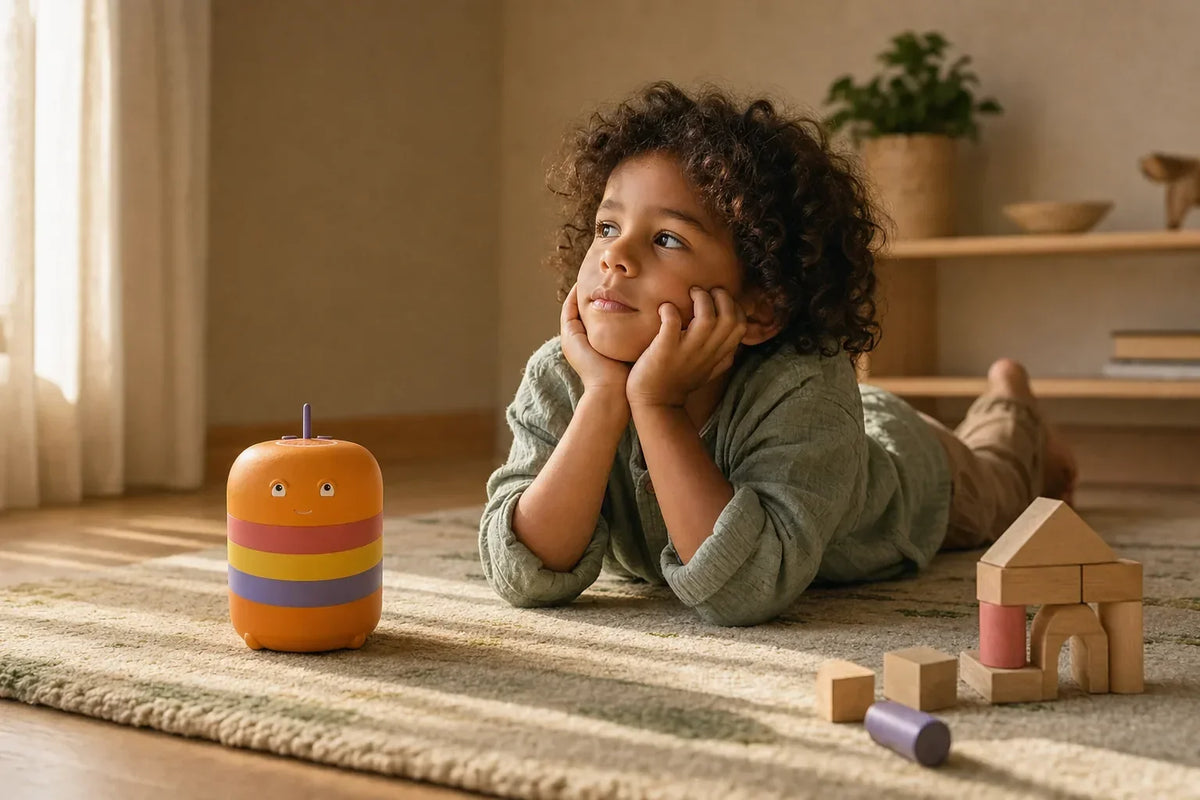
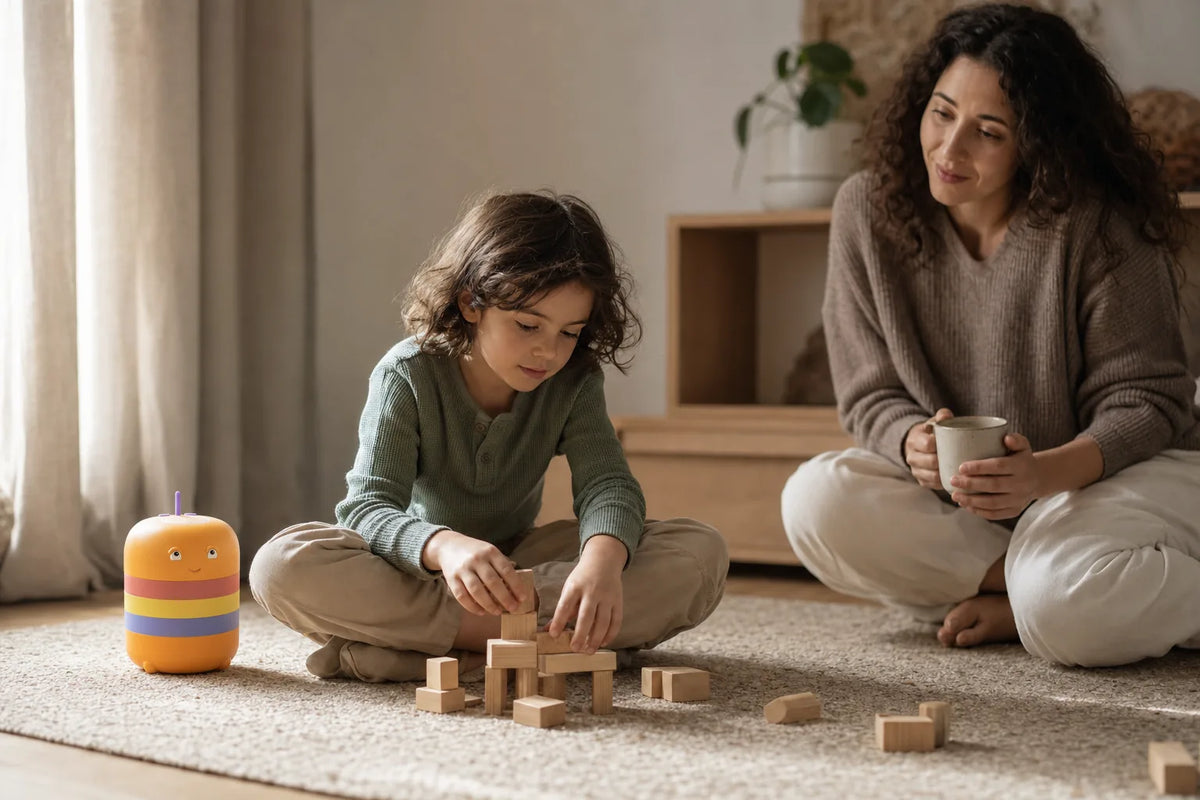
Ohrlaf is a screen-free audio box for children aged three to nine: put a card on, the story plays, take the card off, the story stops. No display, no menu, no suggestions for the next thing. For a media usage contract, this primarily means that the line "How does it stop?" almost fills itself out for audio media – and that the time for it is already managed separately from screen time in the BIÖG guidelines.
Which formats are suitable for which age is in our overview of children's audio plays by age.
Conclusion
A media usage contract is not a parenting trick or a control instrument. It merely shifts the timing of negotiations: away from conflict, to a calm moment at the kitchen table.
Three things determine whether it holds. It must be short enough for your child to understand. It must contain rules for parents, otherwise it's just a written directive. And it needs an expiration date so that it can be renegotiated instead of forgotten.
Start small: three rules, two signatures, a date in four weeks. That goes further than a perfect version that no one reads.
Frequently Asked Questions
What is a media usage contract between parents and child? A jointly created, written agreement about which media may be used for how long, when, and where. It is signed by both parties and ideally also contains rules for the parents. It is not legally binding – its effect lies in its enforceability in everyday life.
What is the 3-6-9-12 rule? A rule of thumb by French psychoanalyst Serge Tisseron from 2008, which distinguishes four age groups: no screen until 3, limited and shared use from 3, creative use and explanation of the internet from 6, discussion about a personal mobile phone from 9. According to a presentation in the parent magazine Fritz+Fränzi, Tisseron later revised the rule and now formulates it less as a rigid guideline.
Is there a media usage contract as a PDF for printing? Yes. A free generator on mediennutzungsvertrag.de – supported by Internet-ABC and klicksafe – allows you to compile an individual contract, output it as a PDF, print it, and later open and modify it using a code. Alternatively, you can copy the template further up in this article.
From what age is a media usage contract useful? As soon as a child understands that an agreement still applies tomorrow – for many children, this is around four years old, often in picture form. The templates of the official generator, according to Internet-ABC, are designed for age groups up to twelve and over twelve years and must be greatly simplified for younger children.
How much screen time is acceptable for children? The Federal Institute for Public Health recommends no screen media at all for children under three, a maximum of 30 minutes daily for 3- to 6-year-olds, and 30 to 45 minutes of leisure time for 6- to 9-year-olds. For audio media, the values are higher: 30, 45, and 60 minutes.
Do audio plays count as screen time? No. The BIÖG lists audio media in its table as a separate category with its own, more generous maximum values. Therefore, it makes sense to have two separate lines in the contract. This does not mean that listening for an unlimited time is good – there is also a guideline for that.
What should be included in a media usage contract? Six things: permitted time, permitted content, permitted locations, explicitly media-free times, a rule for stopping, and rules for parents. Plus a date when you will review the contract together.
Sources
- Federal Institute for Public Health (BIÖG), kindergesundheit-info.de: How often and for how long can children use media? — Basis for all time specifications in this article
- Federal Institute for Public Health (BIÖG): Media in family life — Recommendations on role models, devices in children's rooms, mealtimes, and the last hour before bedtime
- Media Education Research Association Southwest: KIM Study 2024 — 1,225 children aged 6 to 13 surveyed, information on audio play and audiobook usage (p. 30)
- SCHAU HIN!: KIM Study 2024: Childhood is becoming increasingly digital — Evaluation of rule quotas in families (TV duration, online videos)
- klicksafe: Find rules, avoid disputes – with the media usage contract
- Internet-ABC: Media Usage Contract — Age groups for rule templates, parent rules
- mediennutzungsvertrag.de — Free generator, PDF output, operator
- Fritz+Fränzi: The new 3-6-9-12 recommendation from Serge Tisseron
Note on factual basis: All specific numerical data in this article come from the sources linked above and are directly linked in the text. Statements without a source – such as the age table for contract drafting, the contract template, and everyday tips – are explicitly marked as practical observations and should not be interpreted as study results. This text does not replace a medical or therapeutic assessment.

Leave a comment
This site is protected by hCaptcha and the hCaptcha Privacy Policy and Terms of Service apply.